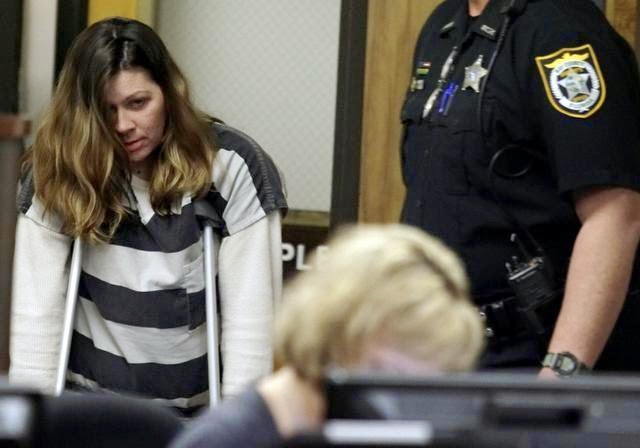
Over a dozen turbulent years, Kaylee Ann Rice was in and out of
state care as her troubled mom parented in a fog of drugs and violence.
Courtney Coughlin’s rap sheet stretches 19 pages, peppered with weapons,
battery and drug charges. She had been to jail twice, attempted suicide
twice and was committed once.
Yet Kaylee, who first came to the attention of state child welfare authorities as an infant, was always returned to her mother.
The
cycle ended when Kaylee was killed. Three days after her 12th birthday,
she died after her mother hurtled through a red light at 90 miles per
hour while fleeing police. She was trying to cash a stolen check. The
girl was not wearing a seat-belt.
When Florida lawmakers overhauled the state’s child protection
laws this session, they also took aim at the state Department of
Children & Families’ sometimes ill-fated decisions to return
vulnerable youngsters to drug-abusing and dangerous parents.
The
child welfare bill, still awaiting Gov. Rick Scott’s signature, gives
Community Based Care groups — private organizations contracted by DCF to
provide child welfare social services — a chance to raise objections if
they think reunification will leave a child in danger.
“We wanted
to have a role in the conversation about reunification,’’ said Kurt
Kelly, who heads the Florida Coalition for Children, which represents
the state’s CBCs. “Because we are providing the services, we are often
the closest to the families and can contribute to the decision about
whether a child can be safely reunified.’’
Over the past five
years, more than two dozen children have died after either they or an
older sibling were reunited with volatile, lawless or drug-using
parents. The parents were shown mercy. The children weren’t.
In
the most recent case, a Sanford toddler, Tariji Gordon, was killed three
months after she was returned to her troubled mother, who had been
stripped of custody after smothering Tariji’s twin brother. The first
death was originally ruled accidental, but it appears to be under
investigation again.
“The decision to reunify is similar to the
decision to remove; it’s the most important decision we make in the life
of a case. Sometimes we make the decision to reunify parents because
they have completed the list of tasks that was given to them,’’ said DCF
interim Secretary Mike Carroll. “But there is not a whole lot of
analysis to determine whether the tasks resulted in a change in
behavior, or mitigated the safety concerns that led us to remove the
child in the first place.”
He added: “We have to get better, particularly when the case is high risk.”
The
story of DCF reunifications is not as much in the numbers as the
quality of some of the investigations and the decision-making that
preceded them. Even when the agency takes a child away from the family —
a rare occurrence — it will often return the child to his or her abuser
after a parenting class or the signing of a promissory pledge.
State
Sen. Denise Grimsley, R-Sebring, who co-wrote the overhaul bill, said
she didn’t realize the state had an issue with risky reunifications
until recently, following Tariji’s death. Representatives of Central
Florida private foster care agencies visited her, and expressed deep
concerns about DCF’s reluctance to give them a seat at the table when
decisions were made on whether to return children to their parents.
“They
were telling me how many cases they had where they would recommend that
a child not be reunified, yet the data and documentation was never
heard in court. They would submit it to DCF, and they would not be able
to make it available” to a judge, said the Republican, who chairs the
Senate Appropriations Subcommittee on Health and Human Services. “I was
horrified by what was going on.”
Tariji’s death
That
conflict came into sharp focus with the death of Tariji. The 2-year-old
and her surviving siblings were returned to their mother, Rachel Fryer,
after two years of living in a foster home. Early on, a court-appointed
guardian ad-litem in the case expressed concern about Fryer’s ability
to provide for her family. Tariji was dead within three months of moving
back with Fryer, who is now in jail, charged in her daughter’s death.
Fryer
is accused of killing the girl, then stuffing her body in a suitcase
and burying her in a shallow grave in Putnam County, 50 miles from her
Sanford home. Fryer denies the allegation, saying she found Tariji
unresponsive and tried to save her with CPR and asthma medication.
Less
than three years earlier, Fryer suffocated Tariji’s twin, Tavont’ae, as
mother and son slept together on a couch. After the 2-month-old’s
death, DCF asked a judge to permanently sever Fryer’s parental rights to
her four surviving children — she had surrendered her rights to two
other older children in an earlier, drug-related case. After the
infant’s death was ruled an accident, Tariji and the three siblings were
returned to their mother in November, 2013. She died in February.
In
January, the guardian — tasked with advocating for the best interest of
the child — requested a hearing on Tariji and her siblings’
reunification, citing “pressing concerns.” It was never scheduled.
In
a court hearing weeks before, on Dec. 9, the guardian told a judge she
believed the children were content and showed Fryer affection, but she
was concerned about the mother. “The children are happy to be home with
their mother. There are some concerns about the mother’s stability. Her
income, I believe, is based on student loans...she has been having
difficulty paying rent and having funds for food in less than a month
that the kids have been home,’’ the advocate said.
At the same
hearing, a DCF lawyer said there were no issues related to the
reunification or the children’s safety. The judge signed off on DCF’s
plan to reunite Fryer, 32, permanently with her four children, but said
she wanted the case to be closely monitored. A final review of the case
was to be set for this month.
Tracking numbers
In
2007, DCF completed 10,877 reunifications of children with their
parents. There was an average of 24,646 children in care that year at
any given time. As DCF pursued a policy of reducing the number of
children in out-of-home care over the next several years, reunifications
dropped, because there were fewer children to reunify. In 2008, DCF
approved 9,252 reunifications; 7,686 in 2009. The number of
reunifications cases has essentially remained flat since 2010 at between
5,877 in 2010 and 6,806 in 2012.
Three years ago, William De
Jesus knocked on the door of a Canadian couple’s trailer in a snowbird
community, the beginning of a murderous rampage in Deerfield Beach in
which the 41-year-old man killed the owner and took the owner’s wife
hostage. He stabbed his own wife and sons and then killed himself. De
Jesus’ oldest son, Jeshiah, who was autistic, died. The 7-year-old
younger brother was gravely injured with a knife blade lodged in his
head. The boys’ mother, 37-year-old Deana Beauchamp, was also injured.
She
would later be convicted of aggravated manslaughter and child neglect
in the knife attack and is serving a 10-year sentence for the crime of
not protecting her children.
The ‘Monster’
The
bloodshed happened a year after DCF reunited the boys with their
father, though the agency had verified allegations that De Jesus was
both violent and abusive. The younger son told child welfare authorities
that he had recurring nightmares and called his father the “Monster.”
This
was not the first time De Jesus had been in trouble. After accusations
of abusing his ex-wife and their children from a previous marriage
several years before, New York had state permanently severed De Jesus’
parental rights.
De Jesus and his new family — Beauchamp, Jeshiah
and the youngest boy — came to the attention of Florida child welfare
authorities in the fall of 2007. A child abuse hotline report accused
the dad of choking Beauchamp during a drinking binge. She told DCF
investigators that the incident was just the latest assault over a
period of years.
DCF responded by asking a judge to order the
family to accept the agency’s help and supervision, but left the boys in
the home. The following year, Beauchamp left De Jesus and moved into a
domestic violence shelter. She told authorities they had both molested
their sons repeatedly, an allegation that had arisen in New York, as
well.
The boys were removed from the home immediately. While in
foster care, more troubling allegations emerged. A therapist and
court-appointed guardian separately reported witnessing De Jesus
inappropriately touch one of the boys’ private area multiple times. At
the same time, Beauchamp had returned to her husband and recanted her
molestation allegations.
The agency reunified the family,
explaining that it lacked “convincing evidence” that De Jesus and
Beauchamp were unfit to parent — over the objection of those working
with the family. DCF ended its involvement in December 2010. Jeshiah was
killed nearly 14 months later.
By the time Kaylee Rice was 6
months old, she was already on DCF’s radar. The first report evoked a
theme that would repeat over and over: Kaylee’s parents, DCF was told,
used drugs and fought with each other. During the next 11 years, Kaylee
would be the subject of 23 calls to the child abuse hotline, resulting
in 15 investigations.
Most of the reports involved mother Courtney
Coughlin’s drug addictions, which a DCF report said began when she was
12. In all, Coughlin reportedly abused the painkillers oxycodone and
Lortab, Xanax, the anti-anxiety drug Klonopin and Ecstacy. In 2003, DCF
was told Coughlin slept all day, and Kaylee had to be fished out of a
pool before drowning.
Coughlin’s criminal history portrays a life
of drug abuse and violence. Beginning in 1997, she faced charges of
cocaine, marijuana, synthetic narcotic and pill possession, sale of
hallucinogens, aggravated battery, and aggravated assault with intent to
kill, among others.
DCF administrators took Kaylee from her
mother at least twice — the state records are unclear about additional
removals. And Kaylee lived with grandparents when her mother was
incarcerated.
Kaylee’s last removal occurred in 2004, when
Coughlin was arrested on drug charges. In late 2008, the girl’s
grandmother, who was caring for her while Coughlin was in prison, fell
and broke her hip. DCF returned Kaylee to her newly released mom, with a
variety of counseling and parenting services.
Three months after
DCF disengaged from the family, the agency got a new report in June
2010: Coughlin was once again using drugs, had attempted suicide, and
had been committed for psychiatric treatment. Though Coughlin refused to
cooperate with the resulting investigation, and declined a drug test,
DCF took no action to protect Kaylee.
In the days before Kaylee
died, her mother had written a series of bad checks that she had stolen
from a local woman, police said. Then, on July 11, 2011, Coughlin pulled
into the drive-through lane of a Lynn Haven credit union. Police were
called, and they pulled up behind her just as she was leaving the credit
union.
Lynn Haven police stopped their pursuit of Coughlin, a
report said, to avoid collateral damage. But she continued to flee,
eventually speeding through a red light at about 90 miles-per-hour;
Coughlin broadsided another driver, who was critically injured. After
the crash, Coughlin tested positive for opiates.
Coughlin pleaded
guilty to 20 charges, including negligent manslaughter, reckless
driving, and fleeing police. She was sentenced to 25 years. Prison
records say the 38-year-old has her daughter’s name, along with hearts,
tattooed on her right leg.
Following Kaylee’s death, police wrote,
the girl’s maternal grandparents acknowledged that Coughlin “had an
ongoing 15-year fight with drug abuse.’’
Yet a four-page internal
review of Kaylee’s death concluded that nothing in DCF’s 23-report
history with Coughlin was “relevant to the circumstances surrounding the
child’s death.”
Read more here: http://www.miamiherald.com/2014/05/24/4136590/when-child-parent-reunification.html#storylink=cpy